
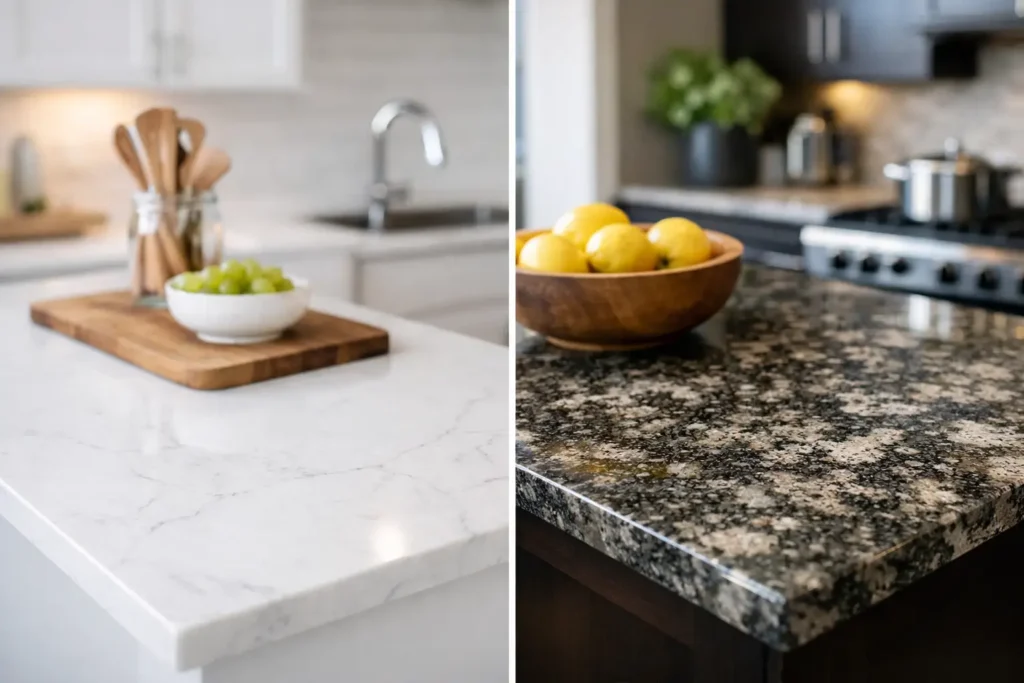
A countertop can make a kitchen feel finished, but it also has to handle real life: hot pans set down too quickly, homework spread across the island, spills during Sunday dinner, and years of daily cleaning. When homeowners compare quartz vs granite countertops, the best choice is rarely about which material is “better.” It is about how you cook, how much upkeep you want, the look you want to live with, and how the countertop fits the rest of your renovation.
Both materials can deliver a high-end result. Both need professional measuring, fabrication, and installation to look their best. The differences show up in the details, and those details matter when you are investing in a kitchen that should work beautifully for years.
Quartz vs Granite Countertops: The Core Difference
Granite is a natural stone cut from the earth. Every slab has its own mineral pattern, movement, and color variation. Even slabs from the same selection can look different, which is part of granite’s appeal. A homeowner who wants a one-of-a-kind surface with natural character is often drawn to granite.
Quartz countertops are engineered surfaces. They are made with ground natural quartz combined with resins and pigments, then formed into durable slabs. Because the material is manufactured, quartz offers more consistency from one area of the countertop to another. It is available in patterns ranging from clean, solid colors to designs that resemble marble or natural stone.
Neither look is automatically right for every home. A heavily veined quartz may suit a bright, updated kitchen with painted cabinets, while a richly patterned granite can bring warmth and depth to stained wood cabinetry. The right sample can look completely different once it is paired with your flooring, backsplash, cabinet color, and lighting.
Daily Maintenance: How Much Work Do You Want?
For busy households, maintenance is often the deciding factor. Quartz is nonporous, so it does not generally need to be sealed. Routine care is straightforward: use a soft cloth, mild soap, and water. It resists many everyday stains from coffee, oil, juice, and sauces when spills are cleaned in a reasonable amount of time.
Granite is naturally porous to varying degrees. A quality sealer helps protect the stone from moisture and staining, but it needs to be reapplied periodically. How often depends on the specific stone, the sealer used, and how the kitchen is used. Some homeowners are comfortable with that small bit of maintenance. Others would rather have a surface that asks for less attention.
Granite also benefits from prompt cleanup, especially around acidic foods and liquids. Properly sealed granite holds up well in an active kitchen, but it is not a material to ignore completely. If a low-maintenance routine is high on your list, quartz has the edge.
Heat, Scratches, and Everyday Durability
Granite has excellent heat resistance. It can handle heat better than quartz, which contains resin binders that can be damaged by very high temperatures or sudden thermal shock. A trivet is still smart for either material, especially for preserving the finish and avoiding stress at seams or edges, but granite is generally more forgiving when hot cookware is involved.
Quartz is very durable for normal kitchen use and resists scratches well. Still, it should not be used as a cutting board. Knives can dull against it, and heavy impacts near an edge or corner can chip either quartz or granite. Dropping a cast-iron pan on any stone countertop is a bad day waiting to happen.
The practical difference comes down to habits. If your household frequently moves hot pans directly from the stove or oven to the counter, granite may offer more peace of mind. If you want dependable resistance to everyday spills and little ongoing care, quartz is usually the easier surface to manage.
Color, Pattern, and the Look of Your Kitchen
Quartz gives homeowners more predictability. You can select a soft white surface with subtle veining, a deep charcoal color, or a warm neutral that stays consistent across a large island and perimeter counters. This makes quartz especially useful when the design calls for a controlled, coordinated appearance.
Granite brings natural variation that cannot be copied exactly. Some slabs are quiet and uniform; others have bold waves, crystals, and dramatic movement. Viewing the actual slab before fabrication is important, particularly when the countertop will be a focal point. A small showroom sample may not show the full range of color and pattern in a full slab.
For many Long Island homes, the countertop decision is tied to a bigger kitchen update. Cabinet refacing or replacement, new flooring, under-cabinet lighting, a tile backsplash, and custom trim all affect how the finished surface reads. A countertop that looks great by itself can feel too busy once every material is in the room. Good planning keeps one feature from competing with another.
A note on seams and edges
Both quartz and granite countertops will usually have seams in larger kitchens or islands, because slabs come in limited sizes. An experienced fabricator plans seam placement carefully, often near a sink cutout, cooktop, or less noticeable section of the layout. The pattern and color you choose can make seams more or less visible.
Edge profiles also change the finished look. A simple eased edge works in almost any kitchen and is easy to maintain. More detailed profiles can add traditional character, but they may collect crumbs and require more careful cleaning. If you have young children, a softened edge can also be a practical choice.
Cost: Look Beyond the Price Per Square Foot
Quartz and granite often overlap in price, especially once you compare quality levels. Entry-level granite may cost less than premium quartz, while a rare or highly dramatic granite slab can exceed many quartz options. The final installed price depends on more than the slab itself.
Measurements, fabrication, sink and cooktop cutouts, edge details, backsplash pieces, removal of existing counters, plumbing disconnection and reconnection, and the complexity of the layout all affect the budget. A large island with waterfall edges will cost more than a straightforward run of countertop, regardless of material.
Rather than choosing based on a single advertised square-foot number, compare complete estimates for the same scope of work. Make sure you understand what is included and what needs to be handled separately. Honest planning at the start helps prevent frustrating surprises once the renovation is underway.
When Granite Is the Better Fit
Granite may be the right choice if you love genuine natural materials and want a surface no neighbor will have exactly. It is also a strong option for serious home cooks who value heat resistance and do not mind periodic sealing. In traditional, transitional, and warm-toned kitchens, granite can add depth that feels established rather than manufactured.
Choose granite with your eyes open. Ask to see the exact slab, not just a sample, and discuss where the strongest veining or color changes will land after fabrication. That is how you get a result that feels intentional.
When Quartz Is the Better Fit
Quartz is often the better fit for homeowners who want a clean, dependable surface with minimal maintenance. It works particularly well in busy family kitchens, contemporary spaces, and designs where a consistent color or marble-inspired pattern is the goal. Its nonporous surface also makes it a practical choice around baking areas, breakfast bars, and heavily used islands.
Just remember that quartz is not indestructible. Use trivets for hot cookware, avoid harsh cleaners, and protect it from excessive heat. With normal care, it can hold its appearance exceptionally well.
Make the Countertop Choice Part of the Whole Plan
The best countertop is the one that supports the way your kitchen works. Think about your cooking habits, the amount of natural light in the room, your cabinet style, and the maintenance you will realistically keep up with. If you are renovating, it also helps to make the countertop selection early enough that cabinet layout, sink choice, backsplash height, and lighting can all be planned around it.
At That Guy Carpentry, we believe the strongest renovations come from listening first and building around the homeowner’s real priorities. Bring samples into the room, look at them in morning and evening light, and choose the surface that makes your kitchen feel like yours – not just the one that looks best in a showroom.