
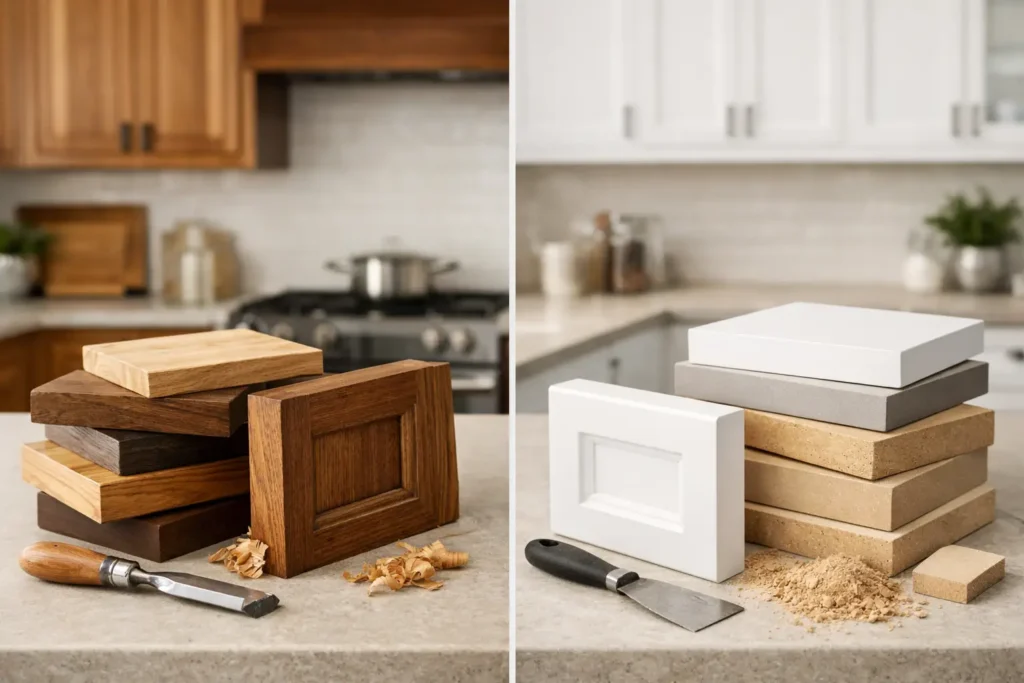
A cabinet door can look great in the showroom and behave very differently after a few Long Island summers, steamy showers, busy weeknight dinners, and years of daily use. When homeowners compare solid wood versus MDF cabinetry, the right answer is rarely as simple as “wood is better” or “MDF is cheaper.” Both materials have a place in a well-planned kitchen, bathroom, built-in, or mudroom.
The better choice depends on where the cabinetry will go, the look you want, how much customization is involved, and where you want to invest your budget. A skilled cabinet plan often uses more than one material for good reason.
Solid Wood Versus MDF Cabinetry: The Real Difference
Solid wood is cut from natural lumber such as maple, oak, cherry, birch, walnut, or alder. Each board has its own grain, color variation, and character. It is a traditional choice for cabinet doors, drawer fronts, face frames, trim, and custom details where the natural beauty of the material is part of the finished design.
MDF, short for medium-density fiberboard, is an engineered wood product made from fine wood fibers, resin, and wax pressed into dense, smooth panels. It does not have a visible grain and is typically painted, rather than stained. High-quality MDF is not the same as inexpensive particleboard. It is denser, smoother, and more stable than many homeowners expect.
The first decision is not always which one to use everywhere. Cabinet boxes, doors, drawer fronts, panels, shelving, and decorative trim all perform different jobs. A custom project can combine materials to get the best balance of appearance, durability, and cost.
When Solid Wood Is Worth the Investment
Solid wood brings warmth that cannot be copied exactly. If you love a stained finish, visible grain, or a classic furniture-style look, solid wood is usually the natural choice. Oak, maple, cherry, and walnut can give a kitchen or built-in a richness that develops character over time.
Wood is also a strong choice for detailed custom work. Raised-panel doors, decorative face frames, island posts, crown molding, and specialty millwork benefit from the depth and crisp profile solid lumber can provide. For homeowners creating a traditional kitchen, a library wall, or a custom entertainment center, those details can make the room feel truly built for the home rather than assembled from standard parts.
Another advantage is repairability. A solid wood door that gets scratched, dented, or nicked can often be sanded, touched up, or refinished. Deep damage may still require a professional repair, but natural wood offers more options than a factory-coated surface. That can matter in active family kitchens and high-use spaces.
Solid wood does come with natural movement. Wood expands and contracts as humidity changes, especially in homes with seasonal temperature swings. Experienced carpenters account for this movement during construction and installation. Still, a wide solid wood panel can shift over time, and painted solid wood doors may eventually show small seam lines at joints. That is not necessarily poor workmanship. It is wood responding to its environment.
Why MDF Is a Strong Choice for Painted Cabinets
For smooth, painted cabinetry, MDF often has a real performance advantage. Because it has no grain, it creates an even surface that accepts paint beautifully. A professionally finished MDF door can have the clean, polished look many homeowners want in white, navy, gray, black, or custom-color kitchens.
MDF is also dimensionally stable in normal indoor conditions. It does not expand and contract across the face the way solid wood does. That makes it especially useful for painted shaker doors, flat-panel doors, large painted wall panels, and decorative trim. The result is less risk of grain texture telegraphing through paint or movement at painted door joints.
Its smooth, uniform core also machines cleanly. That allows for sharp routed profiles and consistent door details. If your design calls for a clean-lined, contemporary look or a tailored transitional kitchen, MDF can deliver a refined finish without paying for lumber grain you do not plan to see.
The limitation is moisture. Standard MDF can swell and lose its shape when exposed to significant water. It is not a material to leave unprotected around a leaking sink, dishwasher failure, or wet basement floor. Moisture-resistant MDF is available for certain applications, but it is still not waterproof. In bathrooms and kitchens, proper installation, durable paint or laminate finishes, careful caulking, ventilation, and prompt leak repairs matter just as much as the material itself.
Cost Is More Than the Price of a Door
MDF generally costs less than premium hardwood, particularly for painted cabinet doors. That can free up budget for better drawer hardware, soft-close hinges, upgraded countertops, improved lighting, custom storage, or a more functional layout. Those upgrades often make a bigger day-to-day difference than choosing an expensive material in every location.
Solid wood prices vary widely by species and construction. Maple and oak are often more accessible than walnut or cherry, while specialty cuts, wide boards, and detailed milling add labor. A wood cabinet project is not just paying for material. It also reflects the time needed to select, join, sand, finish, and fit natural lumber properly.
The lowest upfront cost is not always the best value, though. A cabinet that suits the room, has dependable hardware, and is installed with care can serve a household well for years. It makes more sense to choose materials based on use and finish than to make every decision on a single price point.
Where Each Material Works Best
In a kitchen, painted MDF doors are an excellent option for many homes, especially for shaker or slab-style doors. Solid wood can be a better fit for stained doors, exposed island details, wood hood surrounds, furniture-style pieces, and trim that is meant to show natural grain.
In bathrooms, moisture calls for extra care. Painted MDF doors can work well in a properly ventilated bathroom with quality finishing and no ongoing plumbing issues. For vanity panels close to a shower, tub, or frequently wet area, discuss moisture-resistant options and construction details before making a final selection. The best material cannot compensate for poor ventilation or an ignored leak.
For built-ins, the answer often depends on the finish. MDF is ideal for painted bookcases, window seats, media walls, and custom storage because it creates flat, consistent painted surfaces. Solid wood is a natural choice for stained floating shelves, fireplace mantels, bench tops, and statement pieces where grain and texture are central to the design.
Cabinet interiors are another separate conversation. Many quality cabinet boxes use plywood rather than either solid wood or MDF. Plywood offers good strength, screw-holding ability, and moisture resistance for boxes and shelves. This is why a thoughtful cabinetry plan may include plywood boxes, solid wood face frames or accents, and MDF painted doors.
Questions to Ask Before You Choose
Before selecting a material, think about how the room will actually be used. Are you drawn to a painted finish or a natural stain? Is the space prone to humidity? Will children, pets, and everyday traffic put the finish to the test? Are you hoping to match original woodwork in an older home, or create a clean, modern update?
It also helps to ask how each component will be built and finished. A cabinet door is only one part of the final result. Door construction, edge treatment, paint preparation, hinges, drawer slides, installation, and the way cabinetry meets walls and flooring all affect how the project looks and lasts.
A reputable contractor should be able to explain why a particular material is being recommended for your project, not simply steer you toward the most expensive option. At That Guy Carpentry, that conversation starts with your vision, how your household uses the space, and a realistic plan for your budget.
The Best Choice May Be Both
Many of the best-looking renovations use solid wood and MDF together. A painted kitchen might use MDF shaker doors for a smooth finish, plywood cabinet boxes for strength, and solid white oak shelves or an island accent for warmth. A custom built-in may use painted MDF for the main structure and a solid wood bench top that can handle daily use and bring character to the room.
This approach is not a compromise. It is smart material planning. It puts each product where it performs best and keeps the investment focused on the details you will see and use every day.
Bring finish samples, inspiration photos, and your practical concerns to the planning conversation. The right cabinetry material is the one that supports the way you want your home to look, work, and feel long after the last drawer pull is installed.