
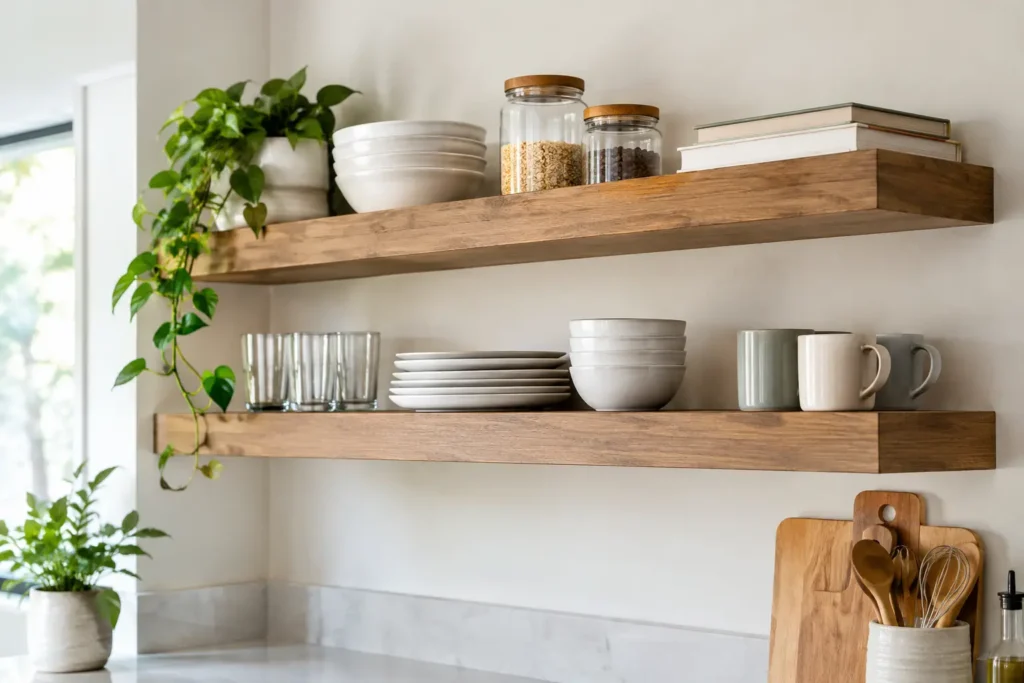
A floating shelf can make a room feel finished without adding the visual weight of brackets or a bulky bookcase. But homeowners are right to ask: are floating shelves strong enough for everyday storage, or are they only meant for a few carefully placed decorations?
The honest answer is that a properly designed and installed floating shelf can be remarkably strong. The catch is that the clean, bracket-free look depends on work hidden behind the wall and inside the shelf itself. Shelf material, wall construction, mounting hardware, shelf depth, and what you plan to store all matter. Get those details right, and floating shelves can hold dishes, books, serving pieces, pantry items, and more. Guess at them, and even a beautiful shelf can sag, pull away from the wall, or damage drywall.
Are Floating Shelves Strong Enough for Heavy Items?
They can be, but “heavy” needs a clear definition. A pair of shelves holding a few framed photos and small plants has very different needs from open kitchen shelving loaded with stoneware, cookbooks, and glassware.
The weight capacity of a floating shelf is not determined by the board alone. It is a system. The shelf must resist bending, its concealed support must carry the load, and the support must be fastened securely to framing or another suitable structural backing. The wall also has to transfer that load safely.
For lighter decorative use, many quality floating shelf systems perform well when attached to studs. For practical storage, a custom-built shelf with a solid internal support structure is usually the better choice. In a kitchen, laundry room, mudroom, or home office, it is wise to plan for the way the space will actually be used six months from now, not just how it will look on installation day.
A shelf that will hold a row of hardcover books or a stack of dinner plates should be designed for that specific load. There is no responsible one-size-fits-all weight number because a 36-inch shelf mounted into three studs behaves differently from a 60-inch shelf attached mostly to drywall anchors.
What Makes a Floating Shelf Strong?
Secure attachment to wall framing
Studs are the most dependable mounting point for a heavy floating shelf. In most homes, studs sit behind the drywall and provide solid wood for structural screws or a concealed mounting cleat to grab. A shelf anchored into multiple studs has a far better chance of staying straight and secure under regular use.
Drywall anchors have their place for lightweight accessories, but they should not be the default plan for shelves intended to hold meaningful weight. Even anchors rated for a certain load can be affected by the direction of force, the condition of the drywall, and the leverage created when weight sits near the front edge of a deep shelf.
Masonry walls require a different approach, using hardware appropriate for concrete, brick, or block. On Long Island, where home construction can vary widely from one neighborhood to the next, checking what is behind the finished wall before building is never a wasted step.
The concealed support system
A true floating shelf generally uses a hidden steel bracket, threaded rods, or a wood cleat and internal framework. This is the part no one sees once the shelf is installed, but it does the real work.
Quality support needs to extend far enough into the shelf to resist the downward pull at the front. A shallow shelf creates less leverage than a deep one. That is why a 7-inch-deep display shelf is easier to support than a 12-inch-deep kitchen shelf carrying a full set of dishes.
A well-built shelf also fits tightly over its support. Excess space inside the shelf can allow movement, and small amounts of movement become more noticeable as a shelf is loaded over time.
Shelf thickness and material
Thin, inexpensive shelves may look clean at first, but they are more likely to flex. Solid hardwood, furniture-grade plywood, and properly constructed wood boxes are common choices for durable custom shelves. The best option depends on the desired finish, span, depth, and intended use.
Solid wood has warmth and character, though it naturally expands and contracts with seasonal humidity. Plywood can offer excellent stability when it is built and finished well. Hollow shelves can also be strong if they are constructed around a substantial internal frame rather than made from thin material with minimal support.
Longer shelves need more attention. The farther a shelf spans between support points, the greater the risk of sagging. Sometimes the right solution is a thicker shelf. In other cases, adding another support point or dividing one long run into separate shelves creates a cleaner and stronger result.
Weight placement
Where you put the weight matters almost as much as how much weight you add. Heavy objects near the outer front edge place more stress on the hidden support. Heavy items grouped in the center of a long shelf can also create a visible dip.
For shelves that will hold books, dishes, or appliances, spread the load across the full length. Keep the heaviest pieces closer to the wall when possible. This is good practice even with professionally installed shelves.
Where Floating Shelves Work Best
Floating shelves are especially useful when a homeowner wants storage without making a room feel crowded. They work beautifully above a coffee bar, beside a fireplace, in a bathroom, over a desk, or along a kitchen wall where upper cabinets would feel too heavy.
In kitchens, open shelving offers easy access to everyday dishes and can make a smaller space feel more open. The trade-off is maintenance. Everything on display collects dust and cooking residue, so choose items you use often or are willing to wipe down regularly. Strong shelves solve the weight issue, but they do not eliminate the need for thoughtful organization.
Bathrooms benefit from shelves for towels, baskets, and daily essentials, especially where floor space is limited. Here, moisture-resistant materials and a durable finish matter. A shelf that looks great but is not sealed properly can discolor or deteriorate in a steamy room.
For a home office or family room, floating shelves can support books and personal items while leaving space below for furniture. Book storage is one of the most demanding uses, so it is worth being upfront about how many books you expect the shelves to carry.
Common Mistakes That Lead to Weak Shelves
The biggest mistake is treating floating shelves as a finish detail rather than a small structural project. The wall is closed up, the brackets are hidden, and it can be tempting to focus only on the wood species or paint color. Those choices matter, but they come after the support plan.
Another common problem is relying on a stud finder reading without confirming the framing layout. Plumbing, electrical wiring, metal studs, blocking, and irregular framing can affect where and how a shelf should be mounted. A careful installer investigates before drilling and adjusts the plan when needed.
Choosing a shelf that is too deep for its support is another issue. Deep shelves are useful, especially in kitchens, but they create more leverage. They may need heavier concealed brackets, more studs, a thicker build, or all three.
Finally, do not underestimate the total load. A few ceramic bowls can weigh more than expected. Add plates, mugs, cookbooks, and serving platters, and a shelf that seemed lightly used can quickly become a heavy-storage installation.
When Custom Carpentry Is Worth It
Off-the-shelf floating shelves can be a good fit for small decorative displays. Custom work becomes especially worthwhile when shelves need to match cabinetry, span an unusual wall, fit around outlets or windows, carry real storage weight, or blend into a larger renovation.
A custom approach lets the shelf support, wood species, edge profile, stain, paint, and dimensions work together. It also allows the installer to account for the actual wall conditions instead of forcing a standard bracket system into a space it was not designed for.
That Guy Carpentry approaches floating shelving the same way we approach built-ins and finish carpentry: start with how you want to use the space, then build the details that make it look intentional and perform well for years. A shelf should feel like part of the home, not a compromise made to fit a package.
Before committing to a design, set the items you want to store on a table and take an honest look at their size and weight. That simple step helps turn a floating shelf from a nice idea into a useful, lasting piece of your home.