
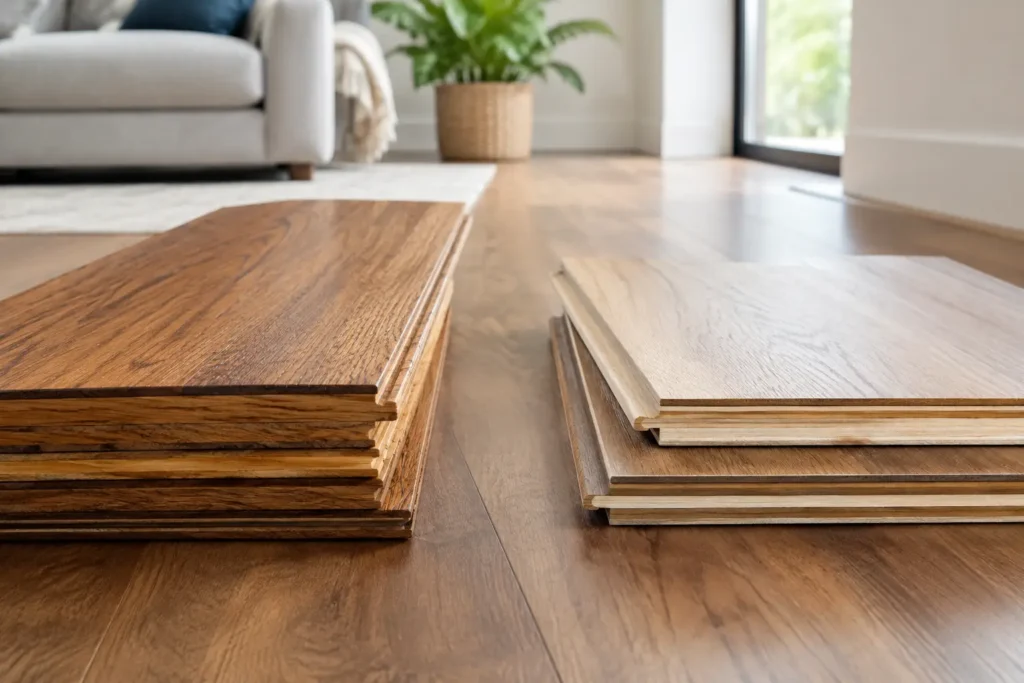
A new wood floor can change how an entire home feels, but the wrong choice can create headaches long after the installers leave. When homeowners ask about hardwood versus engineered wood flooring, the best answer is rarely a simple “one is better.” The right floor depends on the room, the condition of the subfloor, your household’s daily wear and tear, and how long you plan to stay in the home.
Both options can deliver the warmth, character, and lasting appeal people want from real wood. The difference is in how they are built, how they respond to moisture and seasonal movement, and what they allow you to do years down the road.
What separates solid hardwood from engineered wood?
Solid hardwood flooring is milled from a single piece of lumber. Oak, maple, hickory, walnut, and white oak are common choices, each with its own grain pattern, hardness, and color variation. A typical solid hardwood board is usually 3/4 inch thick, and the wood runs through the full thickness of the plank.
Engineered wood flooring has a top layer of genuine hardwood, called a wear layer, bonded to a core of layered plywood or similar stable wood material. It is still real wood at the surface, not a photograph printed on a board. The layered construction is designed to limit expansion and contraction as humidity levels change.
That construction detail matters in Long Island homes, where dry winter heat and humid summer weather can make natural materials move. Solid hardwood moves more with these seasonal changes. Engineered wood is generally more dimensionally stable, especially when it is properly installed over a suitable subfloor.
Hardwood versus engineered wood flooring by room
Location should guide the decision before color or plank width enters the conversation. A beautiful floor has to perform well where you put it.
Living rooms, bedrooms, and formal spaces
Either flooring type can work very well in dry, above-grade rooms. Solid hardwood is often a strong choice for living rooms, dining rooms, bedrooms, and hallways when homeowners want a traditional floor with the greatest long-term refinishing potential. It has a substantial feel underfoot and can become part of the home’s character over decades.
Engineered wood works just as well visually in these spaces and may be the more practical option when a home has a concrete subfloor, a lower ceiling height, or an existing floor that makes transitions a concern. Quality engineered planks are available in wide boards, natural finishes, and wood species that give a room a custom, finished look.
Kitchens and busy family areas
Kitchens call for a practical conversation. Neither solid hardwood nor engineered wood is waterproof, and both can be damaged by standing water. Still, either may be used successfully in a kitchen when spills are cleaned up promptly and the finish is maintained.
For a busy household with children, pets, and frequent entertaining, engineered wood often earns the edge because of its stability. Choose a finish that can handle everyday traffic and a wood species that matches your tolerance for dents and scratches. A light, wire-brushed, or naturally varied finish can make small marks far less noticeable than a dark, smooth, high-gloss floor.
Basements and below-grade spaces
Solid hardwood is generally not recommended for basements. Concrete can transmit moisture even when a basement feels dry, and below-grade humidity changes can cause solid boards to cup, gap, or shift.
Engineered flooring is usually the better wood-floor option below grade, provided the moisture conditions are tested and addressed first. The right underlayment, vapor protection, and installation method are just as important as the flooring itself. If there is an active moisture issue, solve that problem before installing any finished floor.
Cost is more than the price per square foot
It is tempting to compare only material prices, but flooring budgets should account for preparation, installation, transitions, trim work, and the condition of the subfloor. A lower-priced product can become expensive if the floor underneath needs extensive leveling or repair.
Solid hardwood can cost more upfront, particularly with premium species, wider planks, unfinished material, or a custom stain color. Unfinished hardwood also involves sanding, staining, and finishing on site. The result can be beautiful and highly tailored, but it adds time, dust control, and labor to the project.
Engineered wood has a wide price range. Entry-level products with thin wear layers may be budget-friendly, while high-quality engineered flooring can cost as much as, or more than, solid hardwood. Do not assume every engineered product is the same. The thickness of the wear layer, the quality of the core, the finish, and the locking or tongue-and-groove system all affect performance.
Installation can also shift the equation. Engineered boards may be floated, glued down, or nailed down depending on the product and subfloor. Solid hardwood is typically nailed or stapled to a wood subfloor. The best method is determined by the specific flooring, the room conditions, and the manufacturer’s requirements, not by convenience alone.
Refinishing and repair: think beyond move-in day
This is where solid hardwood has its clearest advantage. Because the board is solid wood, it can generally be sanded and refinished several times over its lifetime. Deep scratches, dated stain colors, and normal surface wear can often be corrected rather than covered up.
Engineered flooring can sometimes be refinished, but it depends on the wear layer. A thicker wear layer may allow one or more professional refinishes. A thin veneer may not tolerate sanding at all. This is a key question to ask before buying, especially if you expect the floor to serve your family for decades.
For isolated damage, both materials can often be repaired by replacing individual boards. The challenge is matching the color of a new board to an older floor that has changed slightly with sunlight and use. Keeping a small bundle of leftover material after installation can make future repairs much easier.
Durability depends on species, finish, and daily life
Wood flooring is durable, but it is not indestructible. A large dog’s nails, a dropped cast-iron pan, grit at an entryway, and rolling office chairs can damage almost any wood surface. The product category alone does not determine durability.
Harder species such as hickory and maple generally resist dents better than softer woods. Oak remains a popular choice because it balances durability, grain character, availability, and refinishing options. A factory-applied finish may provide excellent scratch resistance, while a site-finished floor can offer a smoother, more continuous look with fewer visible seams.
For homes with active families, focus on realistic expectations. Use mats at exterior doors, add felt pads under furniture, clean up water quickly, and avoid harsh cleaners. A floor with a little texture and natural variation often looks better longer because everyday life becomes part of its character rather than a flaw that stands out.
Installation details protect the investment
A floor can only perform as well as the preparation underneath it. Before installation, a professional should inspect the subfloor for flatness, structural soundness, moisture, and squeaks. Flooring materials also need time to acclimate when required by the manufacturer.
Door clearances, floor height changes, stair nosing, baseboards, and transitions into adjoining rooms deserve attention too. These finishing details are where a project starts to look intentional instead of pieced together. They also matter when flooring is part of a larger kitchen renovation, custom millwork project, or first-floor update.
At That Guy Carpentry, the goal is to help homeowners choose a floor that fits the space and the way they actually live, then install it with the preparation and finish work that a long-lasting result requires.
How to make the final choice
Choose solid hardwood when you want a traditional, long-term floor in an above-grade space and value the ability to refinish it multiple times. It is a particularly good fit for homeowners restoring an older home or building a look around custom trim, built-ins, and lasting architectural detail.
Choose engineered wood when stability, installation flexibility, or below-grade conditions are part of the equation. It can be an excellent choice for open-concept living areas, kitchens, concrete subfloors, and homes where wide-plank wood flooring is the goal without the movement concerns of solid boards.
The best floor is not necessarily the most expensive one or the one that looks best in a small showroom sample. It is the one that suits your home’s conditions, your budget, and the life happening on top of it. Bring home samples, view them in morning and evening light, and make the decision with the full project in mind.